Publications

Federated quanvolutional neural network: a new paradigm for collaborative quantum learning

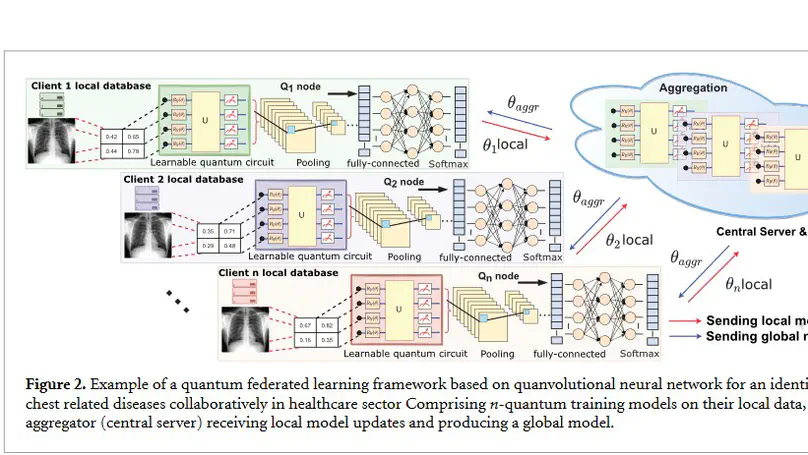
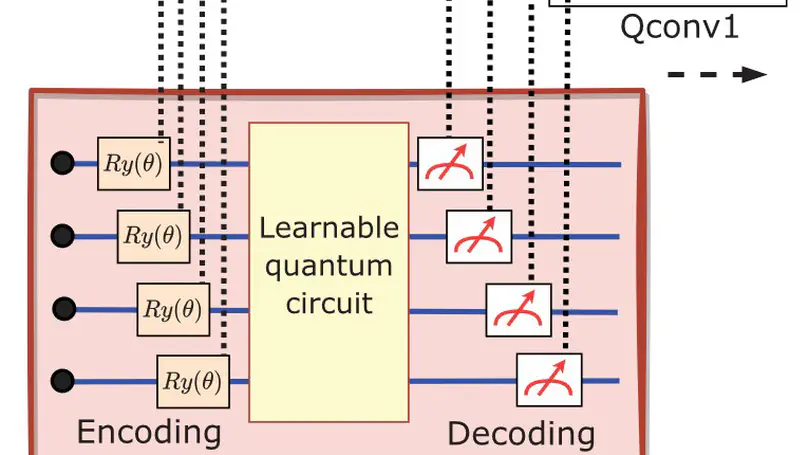
In recent years, the concept of federated machine learning has been actively driven by scientists to ease the privacy concerns of data owners. Currently, the combination of machine learning and quantum computing technologies is a hot industry topic and is positioned to be a major disruptor. It has become an effective new tool for reshaping several industries ranging from healthcare to finance. Data sharing poses a significant hurdle for large-scale machine learning in numerous industries. It is a natural goal to study the advanced quantum computing ecosystem, which will be comprised of heterogeneous federated resources. In this work, the problem of data governance and privacy is handled by developing a quantum federated learning approach, that can be efficiently executed on quantum hardware in the noisy intermediate-scale quantum era. We present the federated hybrid quantum–classical algorithm called a quanvolutional neural network with distributed training on different sites without exchanging data. The hybrid algorithm requires small quantum circuits to produce meaningful features for image classification tasks, which makes it ideal for near-term quantum computing. The primary goal of this work is to evaluate the potential benefits of hybrid quantum–classical and classical-quantum convolutional neural networks on non-independently and non-identically partitioned (Non-IID) and real-world data partitioned datasets among several healthcare institutions/clients. We investigated the performance of a collaborative quanvolutional neural network on two medical machine learning datasets, COVID-19 and MedNIST. Extensive experiments are carried out to validate the robustness and feasibility of the proposed quantum federated learning framework. Our findings demonstrate a decrease of 2%–39% times in necessary communication rounds compared to the federated stochastic gradient descent approach. The hybrid federated framework maintained a high classification testing accuracy and generalizability, even in scenarios where the medical data is unevenly distributed among clients.

Quantum Machine Learning Predicting ADME-Tox Properties in Drug Discovery

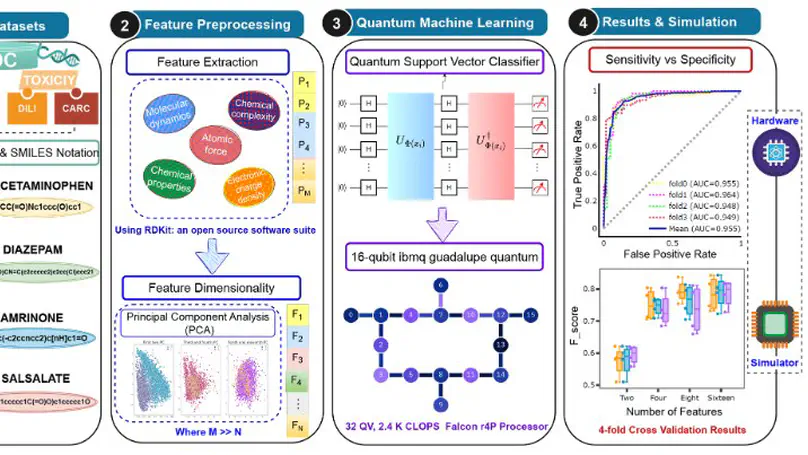
In the drug discovery paradigm, the evaluation of absorption, distribution, metabolism, and excretion (ADME) and toxicity properties of new chemical entities is one of the most critical issues, which is a time-consuming process, immensely expensive, and poses formidable challenges in pharmaceutical R&D. In recent years, emerging technologies like artificial intelligence (AI), big data, and cloud technologies have garnered great attention to predict the ADME and toxicity of molecules. Currently, the blend of quantum computation and machine learning has attracted considerable attention in almost every field ranging from chemistry to biomedicine and several engineering disciplines as well. Quantum computers have the potential to bring advances in high-throughput experimental techniques and in screening billions of molecules by reducing development costs and time associated with the drug discovery process. Motivated by the efficiency of quantum kernel methods, we proposed a quantum machine learning (QML) framework consisting of a classical support vector classifier algorithm with a kernel-based quantum classifier. To demonstrate the feasibility of the proposed QML framework, the simplified molecular input line entry system (SMILES) notation-based string kernel, combined with a quantum support vector classifier, is used for the evaluation of chemical/drug ADME-Tox properties. The proposed quantum machine learning framework is validated and assessed via large-scale simulations. Based on our results from numerical simulations, the quantum model achieved the best performance as compared to classical counterparts in terms of the area under the curve of the receiver operating characteristic curve (AUC ROC; 0.80–0.95) for predicting outcomes on ADME-Tox data sets for small molecules, with a different number of features. The deployment of the proposed framework in the pharmaceutical industry would be extremely valuable in making the best decisions possible.

Benchmarking the performance of portfolio optimization with QAOA

We present a detailed study of portfolio optimization using different versions of the quantum approximate optimization algorithm (QAOA). For a given list of assets, the portfolio optimization problem is formulated as quadratic binary optimization constrained on the number of assets contained in the portfolio. QAOA has been suggested as a possible candidate for solving this problem (and similar combinatorial optimization problems) more efficiently than classical computers in the case of a sufficiently large number of assets. However, the practical implementation of this algorithm requires a careful consideration of several technical issues, not all of which are discussed in the present literature. The present article intends to fill this gap and thereby provides the reader with a useful guide for applying QAOA to the portfolio optimization problem (and similar problems). In particular, we will discuss several possible choices of the variational form and of different classical algorithms for finding the corresponding optimized parameters. Viewing at the application of QAOA on error-prone NISQ hardware, we also analyse the influence of statistical sampling errors (due to a finite number of shots) and gate and readout errors (due to imperfect quantum hardware). Finally, we define a criterion for distinguishing between ‘easy’ and ‘hard’ instances of the portfolio optimization problem.

Cyanobacteria blue-green algae prediction enhancement using hybrid machine learning–based gamma test variable selection and empirical wavelet transform

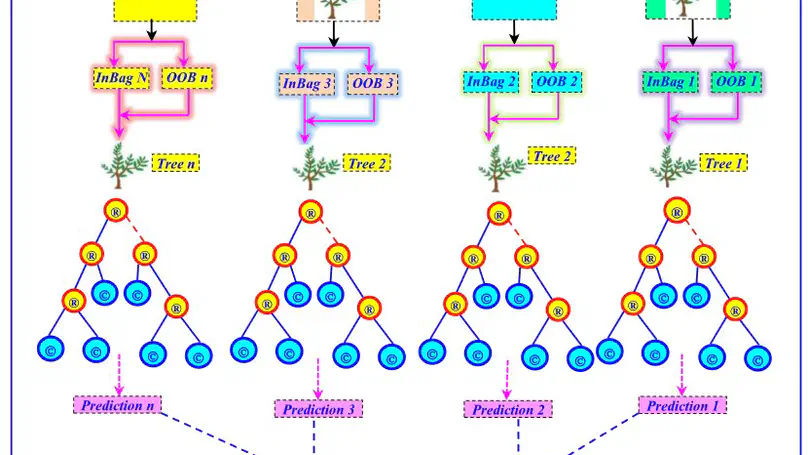
This study aims to evaluate the usefulness and effectiveness of four machine learning (ML) models for modelling cyanobacteria blue-green algae (CBGA) at two rivers located in the USA. The proposed modelling framework was based on establishing a link between five water quality variables and the concentration of CBGA. For this purpose, artificial neural network (ANN), extreme learning machine (ELM), random forest regression (RFR), and random vector functional link (RVFL) are developed. First, the four models were developed using only water quality variables. Second, based on the results of the first, a new modelling strategy was introduced based on preprocessing signal decomposition. Hence, the empirical mode decomposition (EMD), the variational mode decomposition (VMD), and the empirical wavelet transform (EWT) were used for decomposing the water quality variables into several subcomponents, and the obtained intrinsic mode functions (IMFs) and multiresolution analysis (MRA) components were used as new input variables for the ML models. Results of the present investigation show that (i) using single models, good predictive accuracy was obtained using the RFR model exhibiting an R and NSE values of ≈0.914 and ≈0.833 for the first station, and ≈0.944 and ≈0.884 for the second station, while the others models, i.e., ANN, RVFL, and ELM, have failed to provide a good estimation of the CBGA; (ii) the decomposition methods have contributed to a significant improvement of the individual models performances; (iii) among the thee decomposition methods, the EMD was found to be superior to the VMD and EWT; and (iv) the ANN and RFR were found to be more accurate compared to the ELM and RVFL models, exhibiting high numerical performances with R and NSE values of approximately ≈0.983, ≈0.967, and ≈0.989 and ≈0.976, respectively.
Deep learning versus gradient boosting machine for pan evaporation prediction

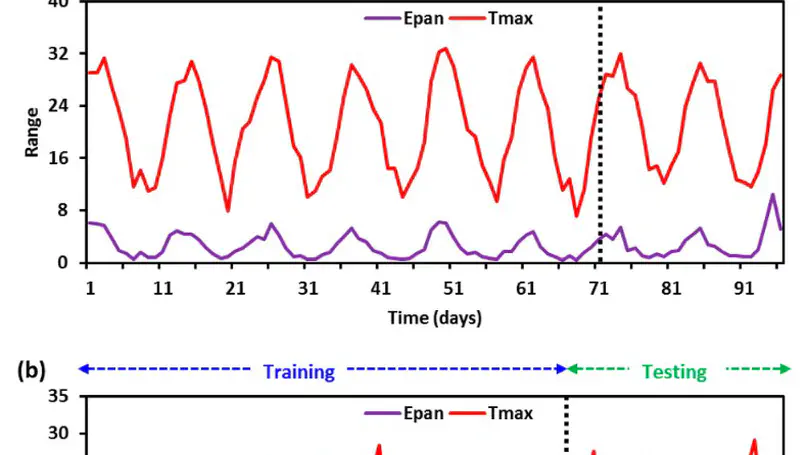
In the present study, two innovative techniques namely, Deep Learning (DL) and Gradient boosting Machine (GBM) models are developed based on a maximum air temperature ‘univariate modeling scheme’ for modeling the monthly pan evaporation (Epan) process. Monthly air temperature and pan evaporation are used to build the predictive models. These models are used for evaluating the evaporation prediction for the Kiashahr meteorological station located in the north of Iran and Ranichauri station positioned in Uttarakhand State of India. Findings indicated that the deep learning model was found best at Kiashahr station for testing datasets MAE (0.5691, mm/month), RMSE (0.7111, mm/month), NSE (0.7496), and IOA (0.9413). It can be concluded that in the semi-arid climate of Iran both of the used methods had the good capability in modeling of monthly Epan. However, DL predicted monthly Epan better than GBM. Moreover, the highest accuracy of the deep learning model was also observed for the Ranichauri station in terms of MAE = 0.3693 mm/month, RMSE = 0.4357 mm/month, NSE = 0.8344, & IOA = 0.9507 in testing stage. Overall, results expose the superior performance of DL-based models for both study stations and can also be utilized for various other environmental modeling.

Proposition of new ensemble data-intelligence model for evapotranspiration process simulation

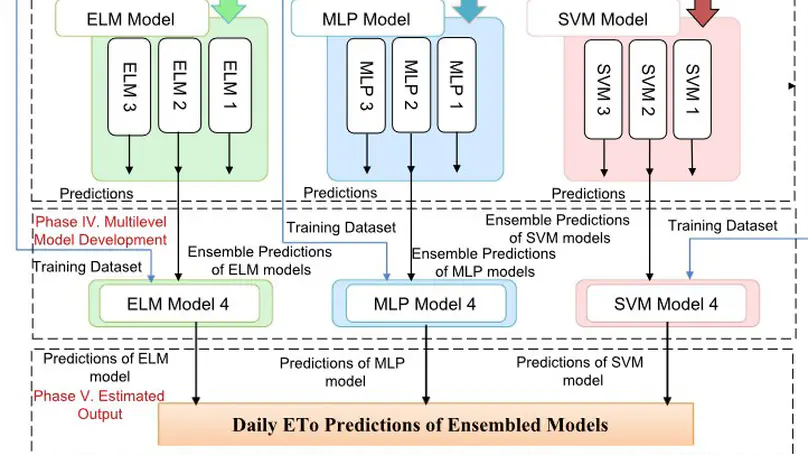
Due to climatic change, a variation in meteorological aspects influences the water requirement for crops, evapotranspiration, and water allocation of agro-meteorological and agriculture. Accurate estimation of Evapotranspiration has great importance to improve the utilization of water efficiently and irrigation scheduling. The main overarching goal of this paper is to investigate the abilities and applicability of three supervised machine learning models: Extreme Machine Learning , Multi-layer Perceptrons-Neural Network, Support Vector Machine to modeling the daily . Further, a three-layer multi-model ensemble machine learning approach is presented to predict evapotranspiration . The first layer consists of different statistical models to produce individual forecasts. The blending approach is employed to create an ensemble of the forecasts generated by the initial layer to produce probabilistic forecasts. In the second layer, three ensemble models are trained for prediction of by using the previous layer predictions and training data. In the third-layer, accuracy is estimated by tuning the parameters of second layer ensemble model. It has been analyzed that all statistical models showed effectiveness in high performance for modeling everyday (e.g. Nash-Sutchliffe efficiency (NSE)= 0.93-0.99, coefficient of determination (r ) = 0.93-0.99, Accuracy (ACC) = 80-99, Mean Square error (MSE) = 0.0103-0.1516). Particularity, the ensemble method with SVM achieved good accuracy (99.46% to 99.72%) to predict the daily and correlation coefficient is closed to 1 on training, validation, and testing datasets. Its root means square error (RMSE) (0.0085 to 0.0935) and Mean Absolute Error (MAE) (0.0614 to 0.0639) are minimum as compared to other ensemble machine learning models.

Variational quantum classifiers through the lens of the Hessian

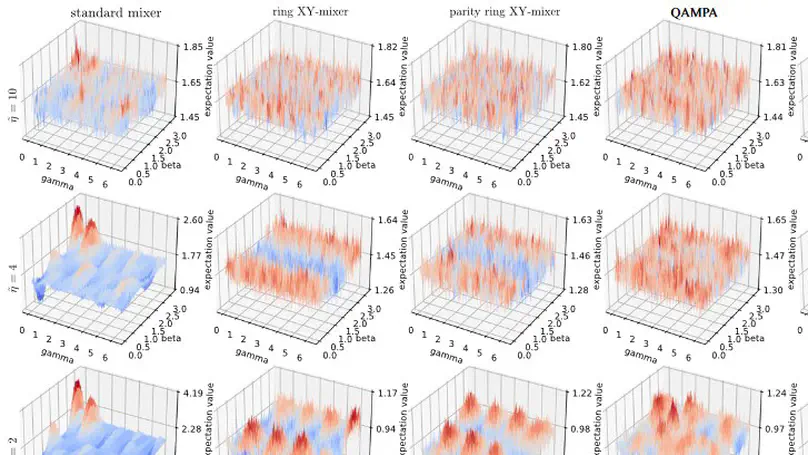
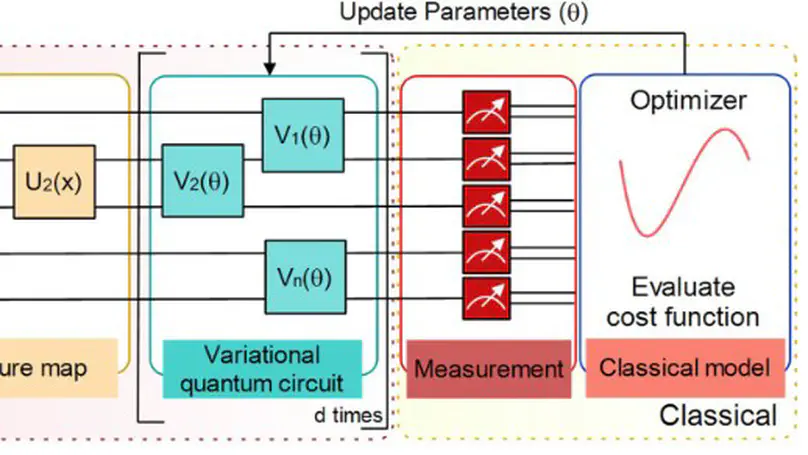
In quantum computing, the variational quantum algorithms (VQAs) are well suited for finding optimal combinations of things in specific applications ranging from chemistry all the way to finance. The training of VQAs with gradient descent optimization algorithm has shown a good convergence. At an early stage, the simulation of variational quantum circuits on noisy intermediate-scale quantum (NISQ) devices suffers from noisy outputs. Just like classical deep learning, it also suffers from vanishing gradient problems. It is a realistic goal to study the topology of loss landscape, to visualize the curvature information and trainability of these circuits in the existence of vanishing gradients. In this paper, we calculate the Hessian and visualize the loss landscape of variational quantum classifiers at different points in parameter space. The curvature information of variational quantum classifiers (VQC) is interpreted and the loss function’s convergence is shown. It helps us better understand the behavior of variational quantum circuits to tackle optimization problems efficiently. We investigated the variational quantum classifiers via Hessian on quantum computers, starting with a simple 4-bit parity problem to gain insight into the practical behavior of Hessian, then thoroughly analyzed the behavior of Hessian’s eigenvalues on training the variational quantum classifier for the Diabetes dataset. Finally, we show how the adaptive Hessian learning rate can influence the convergence while training the variational circuits.

Deep learning under H2O framework: A novel approach for quantitative analysis of discharge coefficient in sluice gates

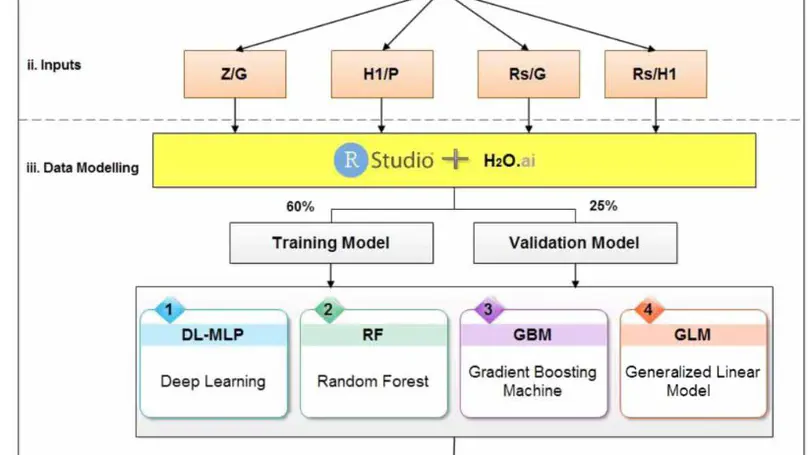
Gates in dams and irrigation canals have been used for the purpose of controlling discharge or water surface regulation. To compute the discharge under a gate, discharge coefficient (Cd) should be first determined precisely. From a novel point of view, this study investigates the effect of sill shape under the vertical sluice gate on Cd using four artificial intelligence methods, which are used to estimate Cd, (i) random forest (RF), (ii) deep learning (DL), (iii) gradient boosting machine (GBM), and (iv) generalized linear model (GLM). A sluice gate along with twelve different forms of sills was fabricated and tested in the University of Tabriz, Iran. Different flow rates were considered in the hydraulic laboratory with four gate openings. As a result, a total of 180 runs could be tested. The results showed that the installation of sill under the vertical gate has a positive effect on flow discharge. Sill shapes can be characterized by their hydraulic radius (Rs). Sensitivity analysis among the dimensionless parameters proved that Rs/G (the ratio of the hydraulic radius of the sills with respect to the gate opening) has a significant role in the determination of Cd. A semi-circular sill shape has a more positive effect on the increase of Cd than the other shapes.

The impact of climate changes on the water footprint of wheat and maize production in the Nile Delta, Egypt

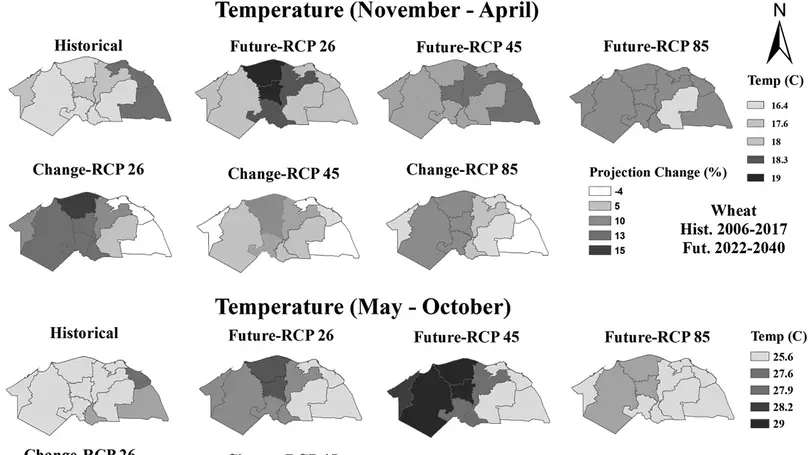
Spatial-temporal information of different water resources is essential to rationally manage, sustainably develop, and optimally utilize water. This study focused on simulating future water footprint (WF) of two agronomically important crops (i.e., wheat and maize) using deep neural networks (DNN) method in Nile delta. DNN model was calibrated and validated by using 2006–2014 and 2015–2017 datasets. Moreover, future data (2022–2040) were obtained from three Representative Concentration Pathways (RCP) 2.6, 4.5, and 8.5, and incorporated into DNN prediction set. The findings showed that determination-coefficient between historical-predicted crop evapotranspiration (ETc) varied from 0.92 to 0.97 for two crops. The yield prediction values of wheat-maize deviated within the ranges of −3.21% to 3.47% and −4.93% to 5.88%, respectively. Based on the ensemble of RCP, precipitation was forecasted to decease by 667.40% and 261.73% in winter and summer in western as compared to eastern, respectively, which will ultimately be dropped to 105.02% and 60.87%, respectively parallel to historical. Therefore, the substantial fluctuations in precipitation caused an obvious decrease in green WF of wheat (i.e., 24.96% and 37.44%) in western and eastern, respectively. Additionally, for maize, it induced a 103.93% decrease in western and an 8.96% increase in eastern. Furthermore, increasing ETc by 8.46% and 12.45% gave rise to substantially increasing (i.e., 8.96% and 17.21%) in western for wheat-maize compared to the east, respectively. Likewise, grey wheat-maize WF findings reveals that there was an increase of 3.07% and 5.02% in western as compared to −14.51% and 12.37% in eastern. Hence, our results highly recommend the optimal use of the eastern delta to save blue-water by 16.58% and 40.25% of total requirements for wheat-maize in contrast to others. Overall, the current research framework and results derived from the adopted methodology will help in optimal planning of future water under climate change in the agricultural sector.