Academic
Academic
Home
Posts
Projects
Talks
Publications
Contact
Light
Dark
Automatic
article-journal
On relation between linear temporal logic and quantum finite automata
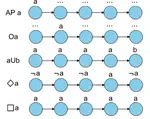
Linear temporal logic is a widely used method for verification of model checking and expressing the system specifications. The …
Amandeep Singh Bhatia
,
Ajay Kumar
PDF
Cite
DOI
The impact of climate changes on the water footprint of wheat and maize production in the Nile Delta, Egypt
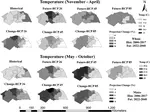
Spatial-temporal information of different water resources is essential to rationally manage, sustainably develop, and optimally utilize …
Ahmed Elbeltagi
,
Muhammad Rizwan Aslam
,
Anurag Malik
,
Behrouz Mehdinejadiani
,
Ankur Srivastava
,
Amandeep Singh Bhatia
,
Jinsong Deng
PDF
Cite
DOI
Matrix product state–based quantum classifier
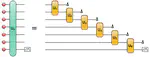
Interest in quantum computing has increased significantly. Tensor network theory has become increasingly popular and widely used to …
Amandeep Singh Bhatia
,
Mandeep Kaur Saggi
,
Ajay Kumar
,
Sushma Jain
PDF
Cite
DOI
Quantum omega-Automata over Infinite Words and Their Relationships
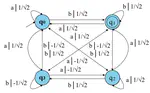
Inspired by the results of finite automata working on infinite words, we studied the quantum ω-automata with Büchi, Muller, Rabin and …
Amandeep Singh Bhatia
,
Ajay Kumar
PDF
Cite
DOI
On the power of two-way multihead quantum finite automata
This paper introduces a variant of two-way quantum finite automata named two-way multihead quantum finite automata. A two-way quantum …
Amandeep Singh Bhatia
,
Ajay Kumar
PDF
Cite
DOI
Modeling of RNA secondary structures using two-way quantum finite automata
Quantum finite automata (QFA) play a crucial role in quantum information processing theory. The representation of ribonucleic acid …
Amandeep Singh Bhatia
,
Ajay Kumar
PDF
Cite
DOI
Neurocomputing approach to matrix product state using quantum dynamics
During the last three decades, quantum neural computation has received a relatively high amount of attention among researchers and …
Amandeep Singh Bhatia
,
Ajay Kumar
PDF
Cite
DOI
Quantifying matrix product state
Motivated by the concept of quantum finite-state machines, we have investigated their relation with matrix product state of quantum …
Amandeep Singh Bhatia
,
Ajay Kumar
PDF
Cite
DOI
Federated quanvolutional neural network: a new paradigm for collaborative quantum learning
We present the federated hybrid quantum–classical algorithm called a quanvolutional neural network with distributed training on different sites without exchanging data. The hybrid algorithm requires small quantum circuits to produce meaningful features for image classification tasks, which makes it ideal for near-term quantum computing. The primary goal of this work is to evaluate the potential benefits of hybrid quantum–classical and classical-quantum convolutional neural networks on non-independently and non-identically partitioned (Non-IID) and real-world data partitioned datasets among several healthcare institutions/clients.
Amandeep Singh Bhatia
,
Sabre Kais
,
Muhammad Ashraful Alam
PDF
Cite
DOI
«
Cite
×